The AI that learns from your audience—not about them
Most marketing tools optimize a snapshot. Motiva optimizes a moving target.

Why your best campaign has a shelf life
You run a test. Something wins. You ship it.
Six months later, that winner is your ceiling—not your floor.
Audiences change. Inboxes get noisier. The message that worked in Q1 is background noise by Q4. And most marketing platforms have no mechanism for noticing, let alone adapting. They were built to execute, not to learn.
How Motiva is different
Motiva uses reinforcement learning with human feedback—the same approach behind the most capable AI systems built today—applied to the specific problem of enterprise marketing.
It also doesn’t need personal data to personalize. Motiva learns at the behavioral level—what patterns drive engagement across your audience—so the results are meaningful and the compliance story is clean.

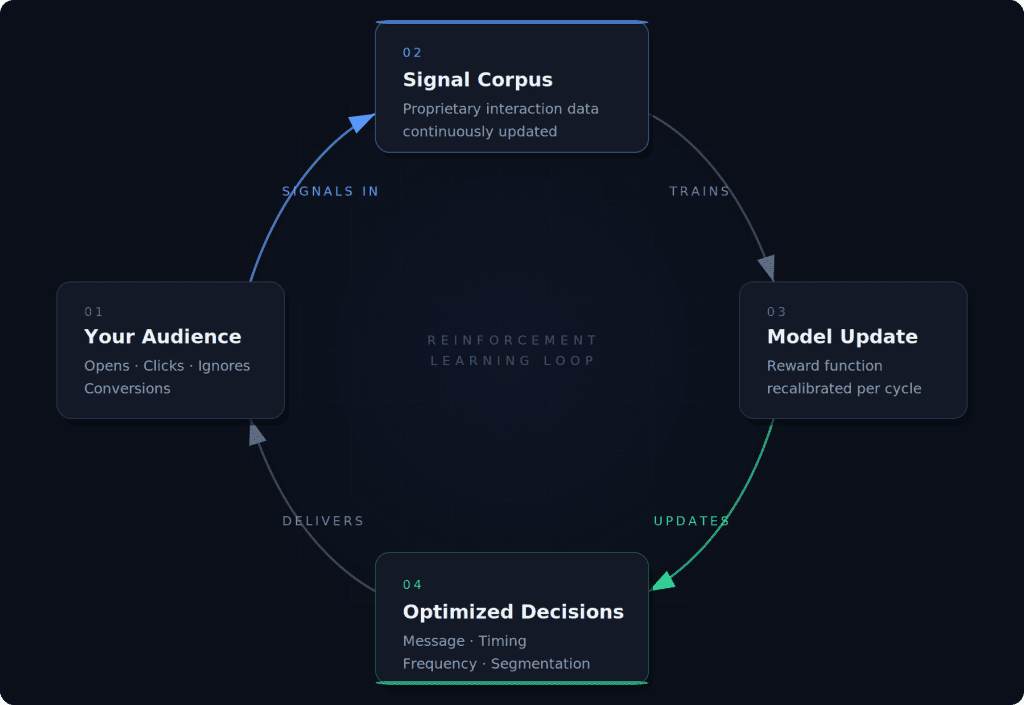
The Motiva learning loop. Every campaign tightens it.

Closing the loop
Most marketing AI optimizes delivery. The harder problem—and the more valuable one—is optimizing creation.
The logical endpoint of what Motiva does is a fully closed loop: where the same signals that optimize send time and segmentation also inform what gets written. RL learnings, audience behavioral patterns, and individual-level context flowing directly into content generation—so the system isn’t just deciding what to send, but helping shape it.
That’s the direction Motiva is building toward. The architecture is designed for it. The signal data that makes it possible is already being collected.
For marketing organizations, it means campaigns that get sharper over time without proportionally more work. For anyone thinking about where AI in marketing is going, it’s the destination the whole field is moving toward—and Motiva is building from the inside out, not retrofitting.
What years in production actually means
Motiva has been running live inside enterprise marketing programs—financial services, healthcare, B2B tech, consumer brands—for years. Not in pilots. In production.
Every campaign that runs on the platform adds to a proprietary body of signal data that makes the models sharper. That’s not something a new entrant can buy or shortcut. You build it by doing the work, at scale, over time.
“If you’re evaluating any marketing AI, the question worth asking is simple: how long has it been in production, and what has it actually trained on?”
It works
Want to go deeper? You can learn more about our approach in this three-part series from our Chief Scientist, Chris Diehl. Have a look!
