
Introducing Uptides AI, Motiva’s new platform for YouTube content optimization — now in beta.
For years, Motiva AI has helped email marketers do more with what they already have — sending the right message, to the right person, at the right time. The through-line across every Motiva product, from Send Time AI to Frequency Management to Dark Pool Data Cleanup, has always been the same: use data to close the gap between good content and the audience it deserves.
Uptides AI is that same idea, applied to YouTube.
Today, we’re announcing the beta launch of Uptides AI — a platform that helps YouTube creators and channel managers automatically optimize video titles to drive more views, more recommendations, and more revenue from their existing content. And we have a case study that shows exactly what it can do.
The Problem With a Growing Back-Catalog
A sports podcast YouTube channel had built something real: 46,300 subscribers, 294 videos, and years of genuinely good content. By most measures, they were a successful channel.
But their analytics told a more frustrating story. The vast majority of their back-catalog — videos that took real time, money, and expertise to produce — was effectively invisible. Older episodes were flatlining at a fraction of their potential, not because the content was bad, but because YouTube’s recommendation engine had stopped surfacing them.
Views per 28-day period were hovering between 74,700 and 118,000. Decent, but plateaued. And no amount of new publishing was moving the needle on the older stuff.
A Different Kind of Optimization
The channel’s team started working with Uptides AI. The hypothesis was straightforward: YouTube’s algorithm and viewers rely heavily on titles to understand what a video is about and how to recommend it. A title that made sense when it was published 3 years ago might be completely misaligned with how people are actually searching and browsing today.
If this logic sounds familiar to Motiva users, it should. The same principle that makes send-time optimization or message testing work — meeting your audience where they are, on their terms — applies just as directly to how a video gets labeled and surfaced on YouTube.
Rather than touching the entire catalog, they started focused. Uptides analyzed content and performance data across the channel and identified 46 underperforming videos — just 15% of the total catalog — as the best candidates for title optimization.
Critically, nothing went live automatically. Every suggested title came to the channel manager for review before being applied to YouTube. The team stayed in control; Uptides just did the heavy analytical lifting.
What Happened When They Flipped the Switch
The early results validated the approach quickly enough that the channel activated Uptides’ Auto Mode — a hands-off setting that allows the tool to continuously re-optimize titles without manual review on every change. The algorithm learns from every approval, rejection, and real-world view outcome, compounding in accuracy over time.
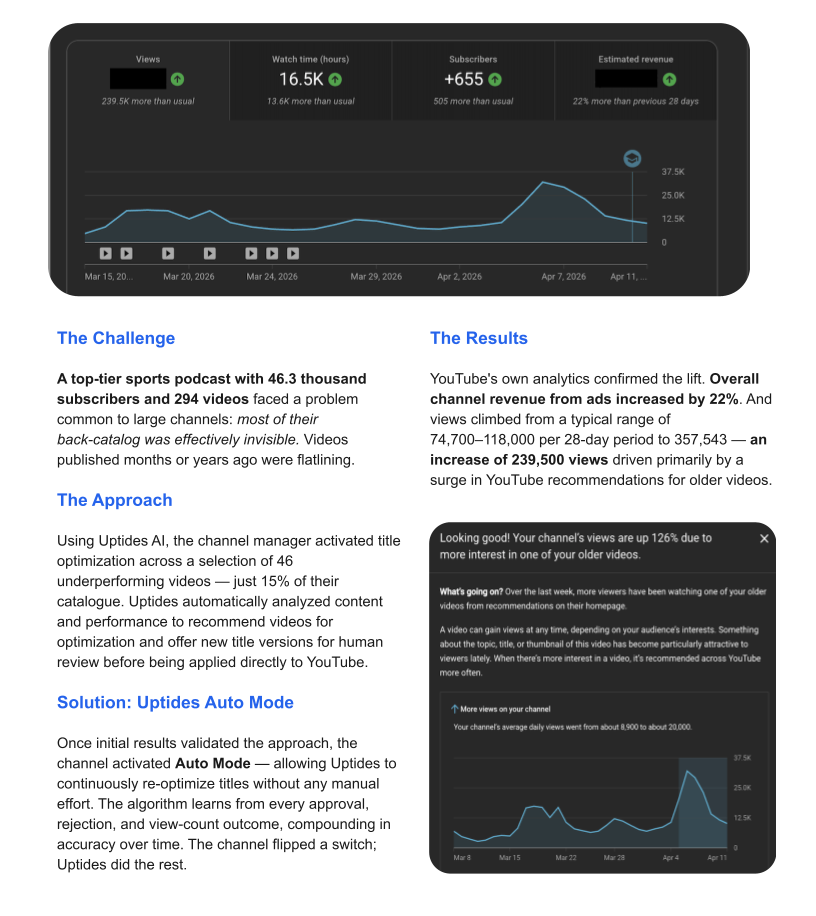
Within 28 days, YouTube’s own analytics confirmed the impact.
Views jumped from a typical range of 74,700–118,000 per period to 357,543 — an increase of 239,500 views. Watch time climbed by 13,600 hours. The channel gained 655 new subscribers, 505 more than their usual rate. And ad revenue increased by 22%.
YouTube even flagged the anomaly in its own interface, notifying the channel that views were up 126% due to renewed interest in older videos. Average daily views went from roughly 8,900 to about 20,000.
The growth wasn’t coming from new uploads. It was coming from the recommendation engine rediscovering content the channel had already made — and finally showing it to the right people.
Why Titles Matter More Than Most Creators Realize
Most YouTube optimization advice focuses on thumbnails, upload frequency, or chasing trending topics. Titles tend to be treated as an afterthought — something you write in the five minutes before you hit publish.
A title is the primary signal YouTube uses to decide who your video is for. A mismatch between your title and your ideal viewer means the algorithm can’t confidently recommend your content — even if the video itself is exactly what that viewer would love.
For channels with large back-catalogs, this is a compounding problem. Every video published with a suboptimal title is a missed opportunity that grows larger over time. Uptides addresses this systematically, the same way Motiva’s email tools address deliverability and engagement decay — not with a one-time fix, but with a continuously learning system.
Introducing Uptides AI Beta
Uptides is now open for beta access. If you manage a YouTube channel — or work with clients who do — and you’re sitting on a back-catalog that isn’t pulling its weight, this is built for you.
What’s included in the beta:
- Automated identification of underperforming videos across your catalog
- AI-generated title recommendations with human review before any changes go live
- Auto Mode for continuous, hands-off re-optimization
- Performance tracking tied directly to YouTube analytics
The Bigger Picture
This case study is a useful corrective to the idea that YouTube growth is purely a function of output. For established channels, there’s often more leverage in optimizing what already exists than in producing more.
For Motiva, Uptides represents a natural extension of what we’ve always done: building tools that help great content find its audience. The channel is new. The philosophy isn’t.
