What you should know and how you can make a difference.

Marketing emails are a cornerstone of daily communication. We use them to engage with customers, announce new products, and drive sales. However, the seemingly innocuous act of sending a marketing email has a hidden environmental cost that many marketers are not aware of.
The Digital Cloud and Its Hidden Costs
When we think of the Cloud, it’s easy to imagine something intangible, a virtual space where our data floats freely. In reality, the Cloud is supported by a vast network of physical infrastructure: data centers filled with servers, cables, and cooling systems. These data centers are the backbone of our digital lives, making everything from emails to video streaming possible.
Every time you send an email, it travels through this infrastructure, consuming energy at every step of its journey and especially at its destination. That email takes up space on a physical server which is always on to allow for 24/7 access to the information. A single email to one contact doesn’t take up much space. But the combined size of a single email sent to hundreds of thousands of contacts is large.
Data centers, which store and process information for the Cloud including emails, are notorious for their high energy consumption. In fact, a single data center can use as much electricity as 50,000 homes. This massive energy use is necessary to keep servers running and cool at all times, preventing overheating and system failures.
Environmental Impact
The energy consumption of data centers has significant environmental repercussions. Many data centers rely on fossil fuels, contributing to their substantial carbon footprint. The Cloud, which includes all these data centers, now has a greater carbon footprint than the entire airline industry. For marketers who send emails frequently, this means every campaign, newsletter, or promotional offer adds to the cumulative carbon emissions.
Beyond carbon emissions, data centers also consume vast amounts of water for cooling purposes, especially in water-scarce regions. This strain on water resources can exacerbate local shortages and environmental stress.
Know Your Impact
In our commitment to environmental sustainability, Motiva has included a CO2 report as part of Dark Pool. The report illustrates the environmental impact of your email marketing in terms of the number of trees it would take one year to counterbalance your carbon footprint. You can see the impact of all your emails as well as the emails you sent that were never opened – what we call wasteful sends.
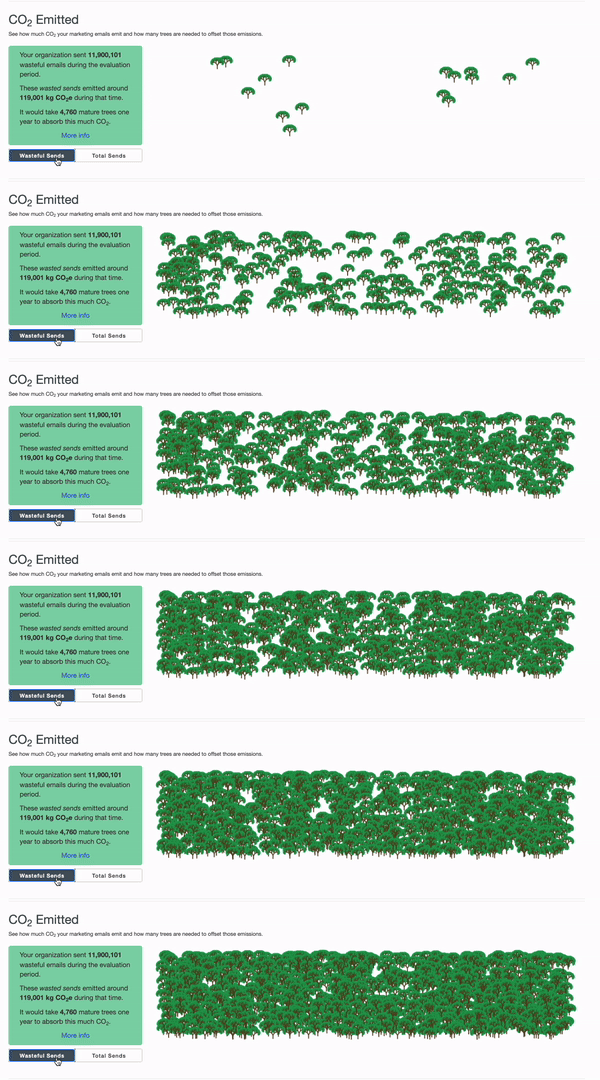
Use our CO2 report to gauge your environmental impact and come up with a plan for reducing your footprint.
What You Can Do
Some tech giants have pledged to reduce their environmental impact by investing in renewable energy and more efficient cooling technologies. However, these efforts are often voluntary and not uniformly implemented across the industry. As marketers, it’s important for us to recognize the role we play in this ecosystem and consider ways to minimize our footprint.
1. Stop Emailing Fatigued & Unreachable Contacts: Emailing contacts who will never engage with your emails and who aren’t maintaining their inboxes means you’re increasing your carbon footprint without any chance of a return on investment. Identify these contacts and stop emailing. Learn more about Dark Pool Data Quality Cleanup.
2. Optimize Email Frequency: Reducing the number of emails sent and optimizing content can significantly cut down on energy use. Focus on quality over quantity. Learn more about Frequency Management.
3. Targeted Campaigns: Sending emails to a more targeted audience ensures that fewer emails are wasted, enhancing both your marketing effectiveness and environmental efficiency. Learn more about quick content optimizations.
4. Monitor Performance: Regularly analyze your email campaigns to ensure they are not only effective but also necessary. Reducing redundant or ineffective emails can help lower your overall impact. Learn more about Performance Reporting.
5. Educate and Advocate: Share information about the environmental impact of digital marketing with your team and stakeholders. Encourage your company to adopt greener practices.
While marketing emails are an essential tool for businesses, their environmental impact cannot be ignored. By taking conscious steps to reduce the frequency and improve the efficiency of your email campaigns, you can help mitigate the ecological footprint of the Cloud. As email marketers, it’s our responsibility to balance business goals with environmental stewardship, ensuring that our digital communications are both effective and sustainable.
