You’re sending too much top-funnel content. Here’s how to stop.

Does your marketing funnel feel more like a lazy river or a water slide?
When developing a marketing funnel, most organizations start with the top of their funnel first: newsletters, blog posts, product announcements and podcasts with low stakes CTAs. This type of content feels less risky and it’s easier to develop. In most cases, all you have to do is research a topic online or speak to a colleague to get the content you need.
But a top heavy funnel drains valuable resources from a marketing team. Soon you’re spending more time on awareness than on the actual goal of qualifying leads. You know what I’m talking about: ever prioritized a newsletter over a direct sales appeal simply because it was that time of the week again?
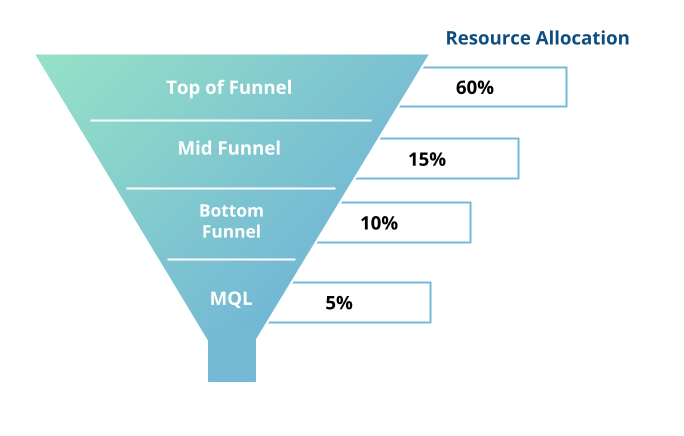
Instead of dedicating resources to building awareness just because “that’s the way we’ve always done it,” we recommend redirecting that effort to improve lead targeting and qualification with bottom-funnel content. Send fewer, more relevant emails and reduce the time to MQL.
Here are five tips to streamline your funnel and get a higher marketing ROI with fewer emails.
1. Focus on real business problems and position your product as the best solution.
Just because everyone else is lobbing top funnel content at their subscribers doesn’t mean you should follow their lead. Ditch the marketing textbook and start talking to your existing customers to build journeys based on them and not on generic “best practices.”
Ask your customers about their real world problems and learn about the challenges they face. Don’t be afraid to dig into the details. Find patterns and build a list of the most common, most painful challenges. These are your opportunities.
If you can develop resources that honestly help your subscribers address these challenges, then they’ll be happy to jump right over the awareness phase and get straight to evaluation and testing.
2. Segment based on problems and content engagement, not on demographics
Generic demographic datapoints like job title, industry and company size can sometimes be useful, especially when you’re trying to close a deal, but they don’t give you enough insight into a subscriber’s full situation to develop useful content. Regulators are also making it harder to use demographic data for targeting so it’s time to find a new approach.
Remember when Netflix first launched its streaming service and everyone was blown away by their detailed genre descriptions? Categories like “dark cerebral dystopian future with a strong female protagonist” and “irreverent action thriller with a sense of humor” made you feel understood and seen.
You want your subscribers to feel seen and to see you as an expert instead of a parrot repeating buzz words and empty catch phrases. Ask detailed and highly relevant questions during opt-in to dramatically improve targeting for bottom-funnel content. Track engagement on specific content that’s related to certain topics and business problems. Build a content profile for your subscribers and get the most relevant content in front of them as soon as possible.
3. Prioritize and optimize bottom funnel content first.
Get to the point. A deluge of top funnel content is like a meandering conversation with so many tangents that it’s hard to even remember why you subscribed in the first place. There is no better time to get someone down-funnel than when they first subscribe. Offer incredible value from the start and get that subscriber into a sales cycle.
Even your opt-in form should be a tool that diagnoses and helps a new subscriber clearly and concisely articulate their challenges. You just did the work for them and that means a lot. Then you’re mid to bottom funnel content will go the extra mile to help them address those challenges and prep them for conversion.
4. Seriously evaluate the effectiveness of all campaigns and don’t be afraid to cut back.
Track performance religiously. Experiment and learn. Don’t be afraid to pull the plug on low performing content and try a new approach. Nothing works forever. In the ever changing landscape of digital marketing, it’s a miracle if a specific tactic works for more than two years.
Specifically track how your send frequency and content impact engagement. Change your frequency limits and content approaches based on fatigue and attempt to secure multiple opt-ins.
5. Implement automated safe-guards to protect your audience and your reputation.
As you analyze performance data, you will uncover insights and identify trends. Act on what you learn by using technology to scale your marketing effectiveness.
For example, Motiva AI’s Frequency Management system allows you to determine the best email frequency for a specific audience and to set automated send limits so you never over send to a contact.
Use Motiva Generator with Custom Brand Voices and Persona Voices automatically analyzes the best performing content for an audience and adapts email copy to be more engaging.
Learn more about how Motiva can address some of your most pressing email marketing challenges by booking a demo.
