
Email testing used to be a slog. You’d carve up your audience into random splits, build duplicate emails, schedule manual sends, wait a few days, calculate results, and—after all that—hope the winning version still mattered by the time you sent it to the rest of your audience.
Motiva’s Automated Multivariate Message Testing changes the equation entirely. It’s the fastest way to turn your Eloqua campaigns into a learning engine in real time — discovering what truly moves your contacts while saving time and resources.
Below are the big questions we hear most from teams adopting Motiva Message Testing for the first time — and the answers that help them make the leap.
“What exactly is Automated Message Testing?”
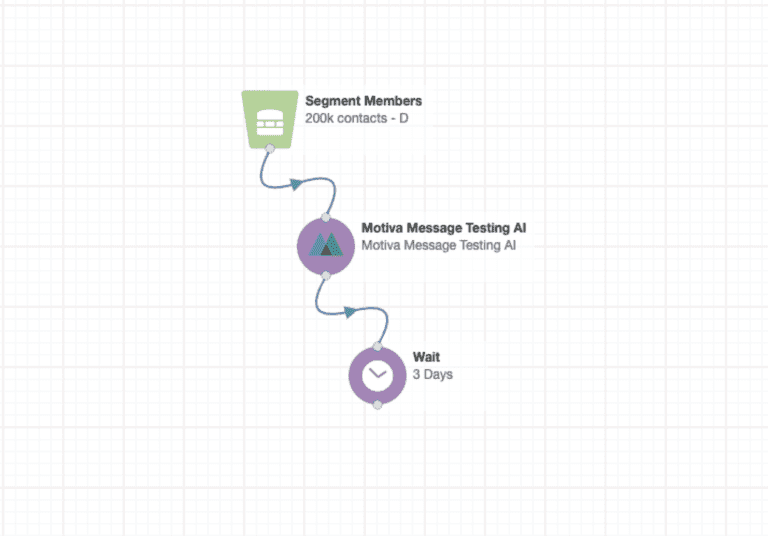
In Eloqua, Motiva’s Automated Message Testing replaces all the manual, time-consuming steps of traditional testing: no more segment splits, manual winner selection, or duplicated email steps.
You simply drop one Motiva step onto the campaign canvas, configure a few options, and Motiva handles the rest:
- Automatic Sampling: Randomized test groups are generated automatically — no manual segment filters or ID splits.
- Adaptive Testing: Motiva runs multiple test rounds over several days, sending more volume to winning versions as confidence grows, while low performers drop out.
- Automatic Analysis: The platform calculates statistical confidence and identifies winners automatically, surfacing the data directly in Eloqua reporting.
In other words, the machine handles the math so marketers can focus on creative strategy — not spreadsheets and p-values.
“What’s the difference between A/B and Multivariate testing?”
Classic A/B testing evaluates one change at a time — maybe a subject line or a sender name.
Multivariate testing, however, allows you to test many variations and/or many variables simultaneously. You can test multiple subject lines and sender personas in the same campaign. Or you can dig deep on one variable with four subject line versions.
Each new version unlocks exponential learning power.
3 version test = 3 A/B equivalent
4 version test = 6 A/B equivalent
5 version test = 10 A/B equivalent
The result? What once took months of serial A/B tests now happens in a single send.
More versions, faster learnings, higher confidence — less time.
“How does adaptive testing actually work?”
Adaptive testing means that instead of sending one big test batch, Motiva sends smaller test batches to each email version every hour over several days. The AI model learns from each smaller test and adapts the distribution of contacts in real time based on average engagement.
- At launch, all versions get equal sends.
- As Motiva learns from each small test, the best-performing versions automatically get more sends.
Underperformers are phased out so your contacts receive only the best performing content.
By the time your campaign completes, the better performing versions of the test are sent to the majority of your contacts. And you’re able to see the progress of the test, the schedule of the batches and the overall performance in a user friendly report instead of digging around Eloqua Insights.
“How many contacts do we need for a valid test?”
Because Motiva builds these smaller test batches, we need a specific number of contacts to gather enough performance data to reach statistical confidence. As a rule of thumb, Motiva recommends roughly 150 contacts per version per send hour to achieve valid statistical confidence within a 2-4 day test window. For example…
- 2 version test over 2 days requires 1,250 contacts
- 3 version test over 2 days requires 2,250 contacts
- 4 version test over 2 days requires 3,000 contacts
- 5 version test over 2 days requires 3,750 contacts
If you’re running a large-audience campaign (like a newsletter), this is easily met; smaller campaigns can still generate directional learnings that guide future creative decisions.
The key is not perfection — it’s progress. Every automated test adds to your organization’s collective understanding of what engages your audience best.
Learn more about why Message Testing has a contact requirement.
“Should we test every email?”
No. Save automated testing for top and mid-funnel programs where you can afford a few days for learning and iteration — newsletters, nurture flows, webinar invite series. Then, apply what you’ve learned to bottom-funnel, time-sensitive campaigns where the goal is conversion, not exploration.
Think of it as building a content intelligence pipeline: your upper-funnel campaigns continuously feed learnings that sharpen your messaging across the entire journey.
“How do we choose what to test?”
Start with your hypothesis:
“[Email element] has an impact on [optimization metric] in service of [business goal].”
Then choose a clear optimization metric — unique open rate or unique click rate — and test the elements most likely to affect that metric:
- Unique Open rate: Subject lines, preheaders or sender name.
- Unique Click rate: Anything in the email body, including CTA copy, images, layout, body tone.
Next, choose several possible approaches for that email element to engage your audience. If you’re testing CTA language, test several, radically different tones to see which approach truly increases engagement.
Each test yields insight into your audience’s preferences and helps refine persona-specific messaging over time.
“What’s a confidence threshold, and why does it matter?”
A confidence threshold is a statistical measurement set during data analysis, often in Message Testing, to determine if a model’s prediction is reliable enough to be used.
A higher threshold requires greater confidence (more engagement data) from the model before a winner is determined, reducing the risk of acting on a false positive.
Motiva’s adaptive model continuously measures engagement and applies statistical confidence analysis to ensure that results aren’t just random noise.
Once a version surpasses the threshold, Motiva automatically routes the remaining contacts to it — locking in a winner only when there’s enough data to prove it.
This approach ensures every winner is chosen based on real signal, not guess.
Learn more about how Motiva Message Testing works under the hood.
“How can we speed up content creation for testing?”
Automated testing works best with bold, distinct versions.
To scale your creative output, pair Motiva Generator with Persona Voice — tools designed to quickly generate on-brand, persona-specific email variants.
Generator can produce multiple subject line, CTA, and tone variations in minutes, giving your team more testable options for legal approval without bottlenecks.
Read more about how Motiva Generator can speed up content development.
The Big Opportunities Motiva Message Testing Unlocks
1. Reliable Insights with Statistical Confidence
Forget anecdotal feedback or vanity metrics. Motiva provides rigorous, data-driven validation of which creative decisions actually move engagement.
2. Faster Testing Cycles with Multivariate Scale
Running one adaptive test with five versions replaces ten manual A/B tests. That’s weeks of saved setup and analysis time.
3. Smarter Content Development
With clear reports showing how each version performed, your team knows why something worked — not just that it did.
4. Continuous Audience Learning
Each test becomes part of a broader learning system that sharpens personas, messaging, and targeting with every campaign.
How to Roll Out Message Testing Without the Headaches
Start small and build momentum.
- Choose a recurring campaign (like a newsletter) with a large segment.
- Test 3–4 versions of a single element (e.g., subject line or CTA).
- Let Motiva run the test automatically for 2–4 days.
- Review the results, discuss insights, and document what you learned.
Next campaign? Add another element to test. Within a few months, your content strategy becomes data-driven with clear insights that drive better engagement.
The Bottom Line
Automated Message Testing can feel like magic — but it’s science. You design the creative, Motiva handles the math.
In return, your campaigns turn into learning engines that uncover what strategy resonates with your audience faster than any manual process ever could.
Learn more by checkout out our Guide to Automated Testing and our post on Message Testing Tips & Tricks.
