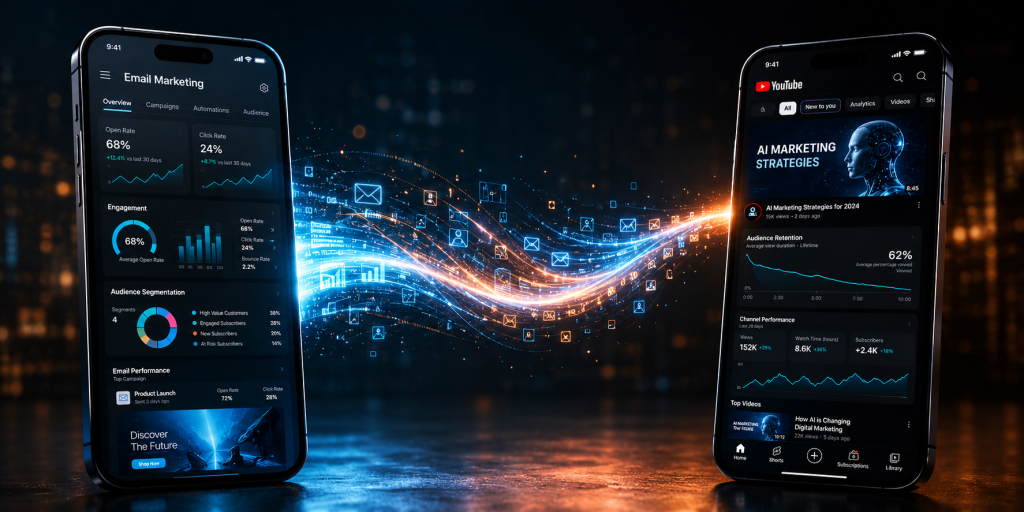
Your email channel already knows what your audience wants. The question is: are you letting YouTube benefit from it?
Most enterprise marketing teams treat YouTube as its own island—a place where you post videos, watch the algorithm work its magic, and hope for the best. But if you’re running Motiva AI on your email program, you’re sitting on a goldmine of audience intelligence that your video team almost certainly isn’t using. Here’s how to change that.
Email: The Best Testing Lab You Already Own
YouTube is a powerful discovery engine, but it’s a slow channel for testing. A/B testing a video title or thumbnail means waiting for statistically meaningful view data—and even then, the signal can be muddied by upload timing, algorithm mood, and subscriber behavior.
Email is different. It’s a controlled, direct, opted-in environment where you can run a multivariate test and get clear results in 24–48 hours. Every subject line you test, every image you swap, every CTA you optimize—it’s all telling you something about what resonates with your core, engaged audience.
Motiva AI makes that learning automatic, structured, and actionable. Let’s break down exactly how our features translate into YouTube wins.
1. Message Testing: Find Your Next Video Title Before You Film
Motiva’s Automated Multivariate Message Testing lets you test subject lines, body copy, and CTAs in parallel—without the manual work of traditional A/B testing. Motiva handles the statistical analysis and surfaces the winners clearly for each audience segment.
Here’s the YouTube connection most teams miss: your best-performing email features (like topic, subject line, imagery and copy) are the building blocks for your next video.
Think about it. If you’re testing three email subject lines like:
- “Cut your reporting time in half”
- “The smarter way to track campaign performance”
- “Stop guessing. Start knowing.”
…and one version drives dramatically higher open rates, that’s not just an email insight. That’s proof of which framing your audience responds to—proof you can carry directly into your video strategy.
How to apply it:
- Use winning subject line language in your YouTube video titles
- Map high-click-through CTAs to your end-screen and description copy
- Let image test winners guide your thumbnail creative direction
- If a specific benefit (“saves time” vs. “reduces cost” vs. “reduces risk”) wins in email, build a video around that angle first
Your email tests run fast and frequently. Your video team should be reading those results every week.
2. Persona Voice: Give Your Video Team a Style Guide That Actually Works
Generic brand guidelines are easy to write and easy to ignore. What video creators actually need is specific, data-driven guidance on what this audience responds to—in terms of tone, language, pacing, and emotional hooks.
That’s exactly what Motiva Persona Voice produces. By analyzing your top-performing and bottom-performing emails for a given segment, Persona Voice automatically generates a style guide that captures the patterns your audience genuinely responds to.
Examples might include:
- Whether your audience prefers direct, punchy language or a more consultative, narrative tone
- The emotional triggers—urgency, curiosity, aspiration, or relief—that drive engagement
- The sentence structures and rhythms that feel natural to that persona
How to apply it:
- Share the Persona Voice style guide with your video scriptwriters and editors
- Use it to align your on-camera tone with what your subscribers already respond to in their inbox
- Feed it into Motiva Generator to automatically produce YouTube description copy, chapter titles, and card text that match the voice your audience trusts
When a viewer gets an email from you Monday morning and watches one of your YouTube videos Thursday afternoon, the brand experience should feel seamless. Persona Voice makes that possible at scale—without endless cross-team briefings.
3. Persona Analytics: Build YouTube Audiences Around the Segments That Actually Engage
Not all subscribers are created equal. Some of your contacts are deeply engaged; others opened once and went quiet. Some care about one topic area; others care about a completely different one. Motiva’s Persona Analytics lets you slice your audience by behavioral patterns and content preferences, giving you a clear picture of who’s responding and why.
This segmentation intelligence is enormously valuable for YouTube content planning.
How to apply it:
- Use high-engagement email segments to define YouTube content pillars—if Segment A consistently over-performs on “how-to” emails and Segment B responds to thought leadership, your video calendar should reflect that split
- Identify which topics produce the best click-to-open ratios in email, then prioritize those same topics in your video upload schedule
- Export your most engaged segment profiles and use them to refine your YouTube audience targeting for paid promotion
YouTube’s algorithm rewards watch time and engagement. Starting with an audience you already know is primed to care is a meaningful head start.
4. Dark Pool: Redirect Inactive Email Contacts to YouTube
Not every contact in your database is an email person. Some of your best potential customers have simply tuned out the inbox—but they’re still visiting your website, still active online, still interested in what you offer. Motiva Dark Pool identifies exactly these contacts: people who are disengaged from email but showing other signs of interest.
Rather than spending effort trying to re-engage them through the same channel that isn’t working, that’s your YouTube retargeting list.
How to apply it:
- Export Dark Pool contacts to use as a seed audience for YouTube remarketing campaigns
- Build “Similar Audience” YouTube ad audiences based on Dark Pool contact profiles
- Create video content specifically designed to re-engage contacts who’ve gone quiet—explainers, product deep-dives, and customer stories that work better as video than email
- Reduce email frequency to this group and redirect your content investment toward video, where they may be more reachable
Dark Pool doesn’t just tell you who’s inactive in email—it tells you where you should be spending your energy instead.
5. Performance Benchmarking: Measure the Feedback Loop
Insights only compound in value when you close the loop. Motiva’s Performance Benchmarking gives you a clean, intuitive dashboard to track email performance against your own baselines and custom benchmarks.
Use that same discipline on the YouTube side of the equation. When you take a winning email insight and apply it to a video—a title, a tone, a CTA structure—track what happens. Did the video outperform your baseline? Did it drive more clicks back to the campaigns your email was promoting?
The compounding insight loop looks like this:
- Email message test → winning value proposition → applied to video title → higher click-through rate
- Persona Voice style guide → updated script tone → improved audience retention → longer watch time → better algorithmic distribution
- Send Time insight → optimized publish window → stronger early engagement → wider organic reach
- Dark Pool findings → YouTube retargeting list → re-engaged prospects who convert
Each cycle teaches you something new. Over time, your email program and your YouTube channel stop being separate initiatives and start functioning as a single, self-improving content intelligence system.
The Bigger Picture: Email Is Your Fastest Feedback Loop
YouTube is slow to test and slow to optimize. Email is fast—days, not weeks. That speed advantage means your email channel can and should serve as the testing environment that informs everything else.
When you run Motiva AI on your email program, you’re not just optimizing opens and clicks. You’re building a continuously updated model of what your audience wants to hear, how they want to hear it, and when. That model has value everywhere your brand shows up—including the 500 hours of video your audience watches every minute.
The smartest video teams aren’t guessing at titles, thumbnails, and tone. They’re reading their email reports.
